 Skip to content
If an outreach email feels generic, it struggles to elicit any sort of engagement. No news there.
According to multiple outreach studies from platforms such as HubSpot, Gong and Woodpecker, most cold email campaigns achieve response rates between 1% and 5%. Campaigns that rely on superficial personalization do not improve those numbers. Meanwhile, studies from Mailchimp have found that emails containing meaningful personalization can increase reply rates by more than 65%, but only when that personalization is extremely relevant to the recipient. Sales engagement platform Gong analysed thousands of outreach emails and found that overly templated messages dramatically reduce response rates, while messages that demonstrate a clear connection to the recipient’s context significantly increase engagement.
So you write emails one-to-one. Personalized. You research the prospect and the prospect’s company. You find relevance, a connection between what you are promoting and the prospect. You look for why they might want to engage with your products/services. Not just that, but you look at what part or aspect of your products/services will work best for them. That works. The worst you get is a polite “no thanks”. The email lands, and you get email deliverability nods from ISPs and mail servers. Modern spam filters increasingly evaluate engagement signals and so low email reply rates harms sender reputation, meaning poorly targeted mass outreach reduces deliverability over time. You move to the next prospect. Research. Send. Repeat. Works well. Well, it does as long as you have an hour or so for each email.
And so enters AI. ChatGPT. We paste in the prompt and the prospect and we get a pretty good email and we send it. You think it’s personalized. It references something that the company has done, ‘congrats on your funding round’, I see you’re hiring’, so ‘buy my stuff’. You wouldn’t do that in your manually researched email. So why does everyone think it’s OK with AI?
The rise of AI personalized email outreach has arguably made the cold email tension worse. AI email software makes it easy to generate huge volumes of messages, but volume does not create engagement. In fact, the opposite happens. When personalization is handled poorly, the email feels painfully artificial. Once that suspicion appears, trust disappears with it, on horseback.
This is why the real challenge in AI outreach is not simply adding more personalization. The challenge is creating emails that are genuinely relevant to the recipient and then scaling that relevance without losing credibility.
The problem is not AI itself. The problem is that AI makes it too easy to scale weak personalization.
Why forced personalization damages credibility
Many outreach emails attempt personalization by inserting obvious facts about the recipient. They mention the job title, the company name, or a vague compliment about the organisation. These details prove that someone looked at a profile, but they do not make the message more meaningful. Quite the opposite.
A line such as “I noticed you are a Marketing Manager at Company X” does not change the logic of the email. It does not explain why the message matters to the reader. It simply announces that the sender collected some data. And that they used AI.
When personalization is handled this way, it creates the opposite of its intended effect. The recipient instantly knows that the sender is sending the same pitch to many people and decorating it with pointlessly personalized bits of information. It’s called Rapid Cognition, a.k.a. the “Blink” moment (coined by the author Malcolm Gladwell), which is the brain’s innate ability to make instant, almost unconscious, and often very accurate judgments based on pattern recognition. You can’t see it because you are too close to the message. You can’t see the wood from the trees. Your email recipients can. Psychologists refer to this phenomenon as rapid cognition, the brain’s ability to make instant judgments based on subtle patterns. Research by Princeton psychologists Janine Willis and Alexander Todorov demonstrated that people form reliable impressions of a face in as little as 100 milliseconds. The same rapid evaluation is exactly the same process when someone reads an email. In other words, your shoe-horned personalization is fooling no-one.
That moment matters. Once a reader believes the email is generated carelessly, the rest of the message is interpreted through that lens. Even strong points can lose their impact because the email no longer feels trustworthy.
For that reason, weak personalization is worse than no personalization at all. A simple and honest email can still create interest. An email that pretends to be personal but fails gets dismissed immediately.
Relevance comes from the connection, not the data
Effective personalization begins with a simple question: why would the reader want to engage with us?
The answer is rarely a stupid random fact about the recipient. Instead, it is a connection between something the organization is already doing and something the sender can help with. A very specific connection.
This connection is what can be described as the personalization hook. It is the very specific element that links the prospect’s organization to the product or service being offered. It must be a very clear and very obvious hook.
A good hook does not exist to show that research was done. Its purpose is not even to demonstrate relevance. It’s there to help the prospect see why engaging makes sense. That’s it.
Starting with real emails written by humans
The most reliable way to build strong outreach emails is to begin without automation. Writing an email manually forces the sender to understand what relevance actually looks like. Find an actual prospect and write an email that beautifully explains the connection.
The goal is to find a meaningful connection between the prospect’s situation and the value being offered. The email should read naturally and should only include details that genuinely scream the connection.
Once several of these emails have been written, patterns begin to emerge. Certain types of hooks appear repeatedly. Certain ways of explaining value feel more natural. Certain proof points resonate more strongly with specific roles or industries.
Once you have the pattern then see if you can use that hook for other prospects. Not the same details, the hook. If the email works by finding out how the prospect uses a service like yours now, or if they use your competitors, if they speak about something surrounding your solution, then you have the hook. Search for that with other prospects. But don’t force it. Accept that not every prospect will have that information. Switch to plan B for that prospect and send a less personalized email or don’t send at all. The technical term is ‘Graceful Degradation‘.
The Three Levels of Personalization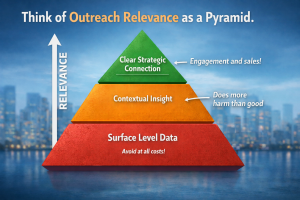
Strategic personalization (clear connection between their priorities and your solution) – your prospects get a nice warm feeling and you get sales.
Contextual personalization (company initiatives, industry signals) – vague ice-breakers that do more harm than good.
Surface personalization (name, title, company) – avoid at all costs.
A practical example of a personalization hook
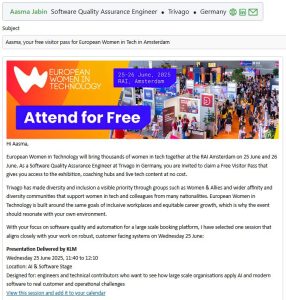
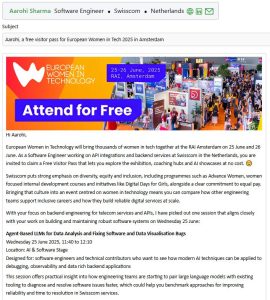
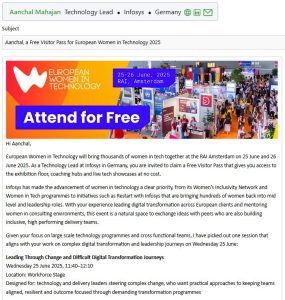
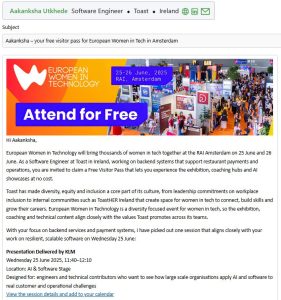
An event organisation called EWiT runs events designed to promote women in technology. When reaching out to potential attendees, the team does not rely on generic invitations. It used to, and it got miserable results.
When using PitchKraft, the outreach began by looking at the organisation where the recipient works. Many technology companies publicly emphasise initiatives that support inclusion and the advancement of ‘women in tech’ roles. These initiatives might appear in company reports, leadership statements, on their websites or other websites that refer to them.
When an email references these initiatives, the message becomes immediately more relevant. The email acknowledges that the organization already cares about the advancement of women in technology. The event is then presented as something that naturally supports that existing priority. The message states very specific things like ‘your organization already demonstrates how important it regards women in tech and inclusion through its ‘Women Empowered USA’ program and your public commitment to 50%…’.
PitchKraft also uses LinkedIn information from the prospect and organization to weave into the email. If the EWiT prospect has just moved into a tech role then the email mentions that as a reason to attend the conference.
The message does not simply invite someone to attend an event. It explains why the event aligns with the organisation’s values and goals. This is the perfect type of personalization that comes only from manual research, expert use of AI, or using AI software that works like manual research. There’s only one we know that does that.
The message, in this case study, may also highlight a specific session at the EWiT event that relates to the recipient’s role and suggests that session to the prospect. It may also mention a testimonial from someone with a similar job title who attended previously. Each element strengthens the connection between the event and the recipient’s professional context.
None of these references exist purely to demonstrate research. They exist because they help explain why attending the event would be valuable. That is what makes the personalization effective.
When EWiT shifted from generic invitations to outreach based on organisational initiatives supporting women in technology, response rates increased significantly. Emails referencing these initiatives produced more than double the engagement rate compared with the previous template approach.
Examples of weak and strong personalization
Consider two different ways an outreach email might begin.
A weak opening might say something like: “I saw that you work as a Software Engineer at Company X and thought you might be interested in our event.” The sentence contains factual information, but it does not explain why the event matters to the recipient or their organisation.
A stronger version acknowledges that the recipient’s organisation actively supports initiatives for women in technology and explain that the event is designed to support exactly that kind of effort. In this version, the personalization provides context and relevance. The message now has a reason to exist.
The difference is important. One message demonstrates that the sender has access to information. Gee whiz. The other demonstrates that the sender understands the recipient’s environment. It reads as though it was researched and written by a human. Even if the prospect thinks its been written by AI, they don’t care because it has actually given the prospect something interesting, hyper-relevant, and something that they might even want. Imagine that.
Keep your branding
As AI personalized email outreach becomes ubiquitous, another problem has emerged alongside weak personalization: brand erosion. AI tools default to their own bland, generic writing style, which means your emails start to sound like everyone else’s. It’s not just em dashes (—), it’s the whole email looking and sounding like every other email out there, and post, blog and LinkedIn article. The same tone, rhythm and sentence structures. That is a serious issue in crowded inboxes, because even a personalized email can still get ignored if it sounds like standard AI output. We explore this in more detail in our article, When AI Writes in Its Own Voice, Your Brand Gets Buried. In this we explain how PitchKraft resolves this by including your brand and style using the reference email example and example outbound email to keep every generated email aligned with your company’s brand, tone, structure and messaging rather than the AI’s default voice.
Where AI email software becomes useful
Once effective outreach emails have been written manually, AI email software becomes essential to scale the patterns that already work. If you can do this as effectively in 10 seconds per prospect then you really have something very powerful.
This is the approach, you may not be surprised to hear, is used by PitchKraft which makes every one of the emails hyper-personalized at scale.
PitchKraft allows users to upload manually written reference emails. These are emails created after real research and careful thinking about relevance. The system analyses these examples, breaks down their structure, and reconstructs the underlying logic that makes them effective so it can create beautifully hyper-relevant emails to all your prospects, one-by-one.
Because the reference emails already contain meaningful personalization hooks, the system can reproduce that style of messaging at scale. The same reasoning that made the original emails work can now be applied across hundreds, or thousands, of prospects.
Using company knowledge to strengthen relevance even further
Personalization becomes even more powerful when outreach emails can draw not just on online research, but also on deep knowledge of your company.
Case studies, testimonials, product documentation, and internal knowledge bases provide the material needed to laser target value.
For example, when an email references a case study involving a very similar organisation or role, the message becomes easier to trust. The recipient can see how the product or service has already helped others in comparable situations.
These materials can be uploaded into PitchKraft, and the system can select relevant proof points that match the prospect’s industry, role, or priorities. The result is outreach that feels fantastically relevant and credible.
Time for some inspirational quotes
As sales strategist Jill Konrath notes, “Relevance beats persistence.” Buyers respond when they feel understood, not when they are contacted repeatedly.
As marketing expert Seth Godin puts it, “People do not buy goods and services. They buy relationships, stories, and magic.”
Maintaining trust while scaling outreach
The most important standard for any outreach campaign is surprisingly simple. Every email should still feel natural if it were written manually for that prospect.
If a piece of personalization would feel forced or unnecessary in a manual email, it should not appear in an automated one. The presence of AI does not lower the standard for authenticity. It raises it.
AI personalized email outreach works best when it scales messages that already feel thoughtful and relevant. When used this way, AI email software becomes a powerful tool for expanding genuine conversations with potential customers.
Scaling real personalization with PitchKraft
PitchKraft.ai helps organisations turn carefully written outreach emails into scalable communication. By analysing manually created reference emails and combining them with company knowledge, the platform generates messages that remain heavily grounded in perfect relevance.
The result is outreach that preserves the tone and credibility of human research while allowing teams to reach, impress and engage prospects.
After analysing thousands of outreach emails across multiple industries, a consistent pattern has appeared. Emails that clearly explain why the recipient should care outperform massively those that simply demonstrate surface level personalization.
Research sources include studies from HubSpot, Gong, Woodpecker, and Princeton University research on rapid cognition.