
 Skip to content
 Warm it up and time it right
Even with great infrastructure and strong content, poor sending practices can quietly destroy your deliverability. Inbox providers pay close attention to how you send, not just what you send. Sudden volume spikes, erratic schedules, or badly timed sends can undo all the work you put into copy and targeting.
Email warm-up is the process of gradually building trust for a new sending domain or inbox by increasing volume over time. When a brand new sender suddenly starts pushing out hundreds or thousands of emails, mailbox providers immediately become suspicious. From their perspective, this looks exactly like spam behavior.
Because of that suspicion, they often throttle delivery, delay messages, or divert emails into spam to test how recipients react. If early engagement is weak or recipients flag messages as spam, your reputation can be damaged, and very quickly. On the other hand, when volume grows slowly and engagement is healthy, providers loosen restrictions and allow more consistent inbox placement.
Warm up is especially important for cold outreach and sales emails. You are contacting people who may not know you yet. A disciplined warm-up period can be the difference between most of your campaign landing in the inbox or most of it disappearing into spam.
For a new inbox, this often means sending only a handful of emails per day at first, if you are sending to cold email recipients. Try to send first to contacts who are most likely to open, reply, or otherwise engage. Early engagement sends strong positive signals that your emails are wanted.
As long as engagement remains healthy and bounce rates stay low, volume can be increased gradually over time. This increase should happen over weeks, not days. If metrics dip, that is a signal to pause or slow down rather than push harder.
During warm-up, quality matters more than quantity. Emails should feel very personal, relevant, and conversational rather than promotional or mass produced. Messages that prompt replies are especially valuable, as replies are one of the strongest indicators of legitimate human communication.
Sending a small number of emails every weekday at roughly the same time works well, but perfect uniformity does not. Introducing small, randomized delays between individual emails helps mimic natural human sending behavior and avoids the appearance of a synchronized blast.
Monitoring performance closely is essential during this phase. If you notice increased spam placement or delivery delays, it is far better to pause and diagnose the issue than to continue sending and burn the inbox further.
When it comes to warm-up tools, we recommend caution. At PitchKraft, we do not recommend fully automated warm-up services that rely on artificial engagement. Instead, we provide a peer to peer warming system operated by real humans with real inboxes. These genuine interactions reflect natural email behavior and build reputation in a safer and more sustainable way.
Timing plays a major role in both engagement and deliverability. Sending too much email at once or sending at times when recipients are unlikely to engage can trigger throttling and suppress future sends.
For B2B cold outreach, mid-weekdays such as Tuesday through Thursday often perform well because people are settled into their work rhythm. Late morning to early afternoon local time tends to be effective, once urgent tasks are cleared but before attention drops later in the day.
Very early morning can work for some senior roles who scan email early but sending too early also risks being buried by the time they actively engage.
For many roles, engagement is lower on weekends, but founders, stakeholders, and C-suite executives sometimes check email more deliberately on weekends when their inbox is quieter and they are less reactive. This can work depending on who you are targeting, and it reinforces the importance of understanding your audience rather than relying on blanket rules.
Avoid sending emails exactly on the hour. Inbox providers often associate precise, synchronized timing with automated campaigns. Sending at slightly irregular times and adding randomized delays between messages helps your outreach look more organic and reduces the chance of throttling.
Follow up timing also matters. Sending follow ups too quickly is a common mistake. Prospects need time to process and respond. Waiting several days between touches and varying the day, time, and pacing of follow ups helps avoid fatigue and increases the chance of catching someone at the right moment.
PitchKraft has a follow-up function that includes your previous email(s) in the email trail so it appears a more natural, human created outreach.
Inbox providers are highly sensitive to sudden spikes in sending volume. Large batches sent all at once often lead to throttling, delayed delivery, or temporary blocks. Spreading sends over a defined window and pacing them with small, randomized delays helps smooth out volume and signal normal behavior. PitchKraft supports all of this.
Steady daily volume performs far better than erratic patterns. Predictable growth and consistent sending habits signal legitimacy, while sharp spikes and stop-start behavior do the opposite.
Most cold sequences perform best when capped at a reasonable number of touches. Beyond that point, returns diminish and the risk of spam complaints increases. If there is no response, it is often better to pause and re-approach later with a fresh angle or some added value.
Modern email platforms like PitchKraft can manage pacing, randomized delays, and time zone awareness automatically. Even without historical engagement data, basic time zone alignment and natural pacing can significantly improve outcomes.
PitchKraft is built with these realities in mind. We ensure emails are sent gradually, with human-like delays, and in patterns that mirror real inbox behavior. Combined with highly personalized content, this approach supports both engagement and long term deliverability.
You’ve gone to the trouble of researching each prospect and writing every email (or you’ve let PitchKraft do that for you) so now you are going to send them all together? Email servers and ISPs are watching and if you send 100 emails at the same time, they are going to know you didn’t write these emails one by one.
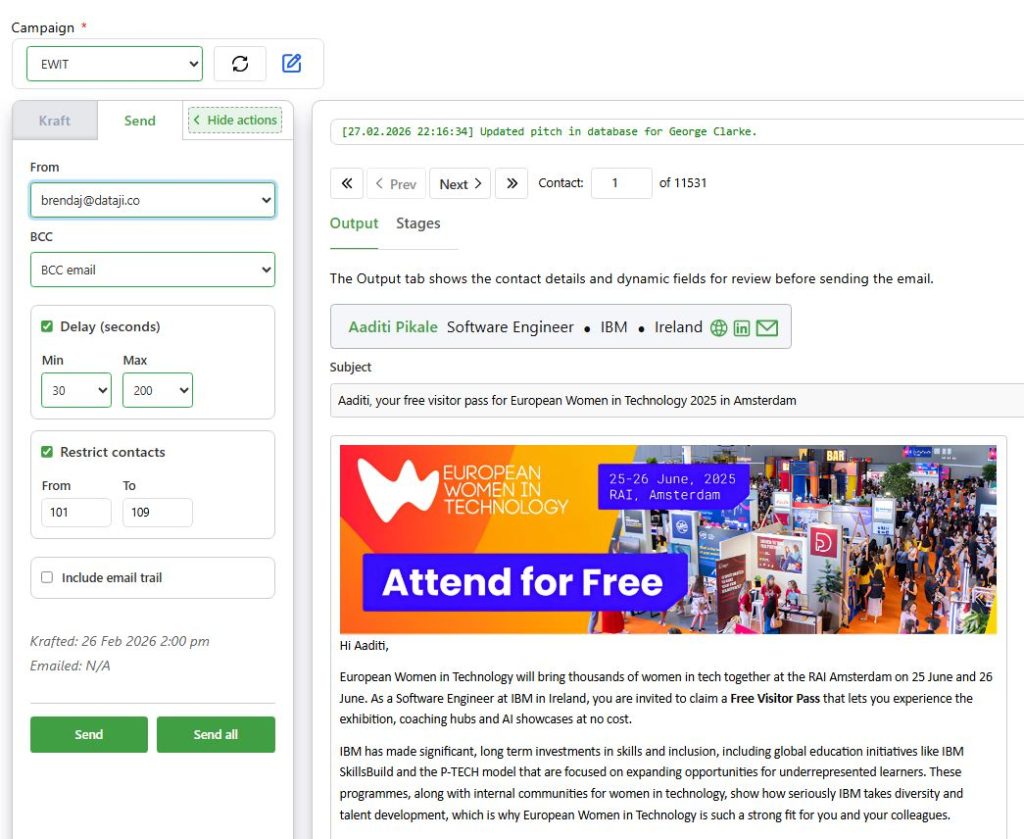
PitchKraft will let you schedule your sends if that’s what you want to do. But it also lets you smartly send them individually with a randomized delay between each email. You can set a minimum time and a maximum and PitchKraft will calculate the random delays. Just pick the shortest amount of time you think it might take to write an email and the longest and PitchKraft does the rest. No need to hang around, get on with other things, as PitchKraft sends in the background.
Get in touch
24/7/365 support comes as standard. We know…this is not normal!

support@pitchkraft.ai

Available on Standard & Premium plans
